
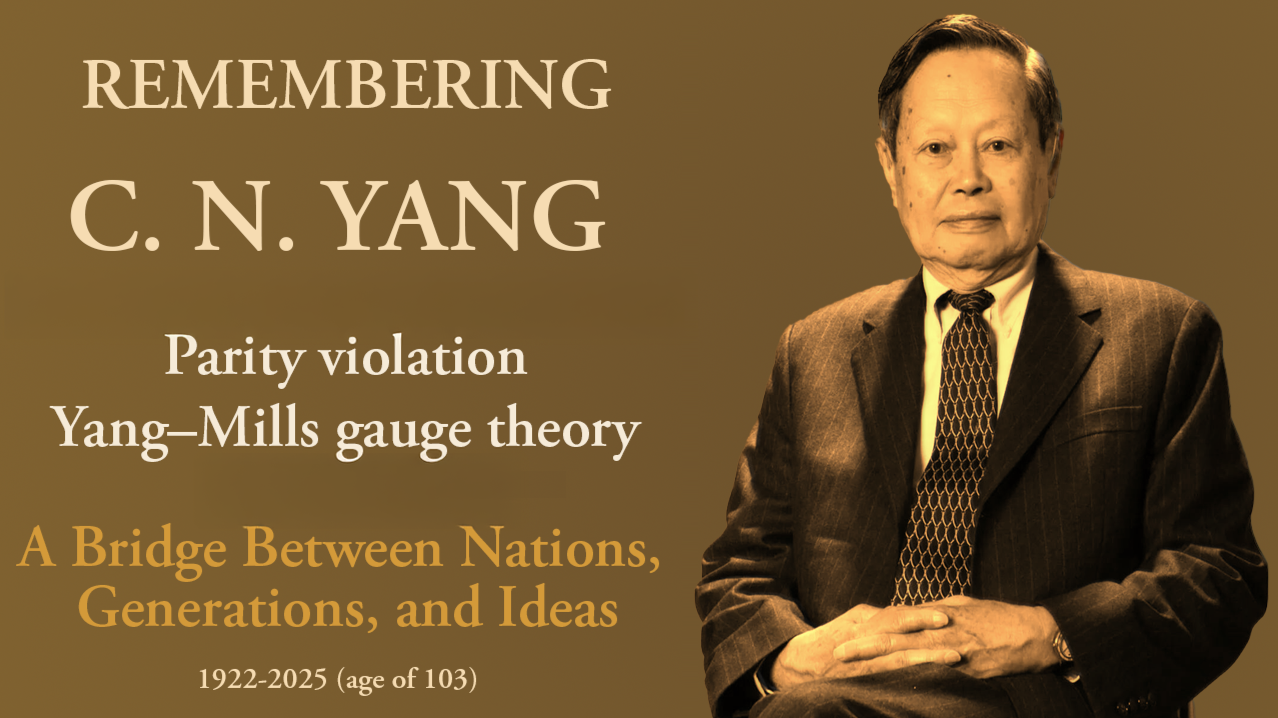
Professor Chen-Ning Yang, the visionary physicist and 1957 Nobel Laureate whose groundbreaking work on parity violation and the formulation of the Yang–Mills gauge theory transformed modern physics, passed away on October 18, 2025, at the age of 103 in Beijing. The Yang–Mills framework—often regarded as a cornerstone of twentieth-century physics alongside Newton’s laws, Maxwell’s equations, and Einstein’s theory of relativity—laid the foundation for the Standard Model, shaping our understanding of the universe’s fundamental forces. Yet Professor Yang’s influence reached far beyond theory: through his intellect, diplomacy, and educational vision, he became a bridge-builder between nations, generations, and ideas.
A Legacy Beyond Discovery
While Professor Yang’s name will forever be linked to the Yang–Mills gauge theory and the discovery of parity nonconservation in weak interactions, his legacy extends far beyond theoretical physics. He saw science not as an isolated endeavor but as a unifying force for humanity, capable of bridging political divides and nurturing generations of thinkers.
In 1979, amid China’s post–Cultural Revolution renewal, Yang joined with his longtime collaborator T. D. Lee to found the China–United States Physics Examination and Application (CUSPEA) program. This pioneering initiative provided a rigorous, merit-based pathway for outstanding Chinese undergraduates to pursue graduate studies in physics at leading American institutions such as Columbia, Princeton, MIT, and others.
The CUSPEA Vision
At a time when China’s scientific infrastructure was still rebuilding, CUSPEA represented more than an academic exchange—it was an act of faith in the power of education, openness, and meritocracy. Over its nine years of operation, the program enabled more than 900 students to continue their education abroad, many of whom became influential figures in particle physics, condensed matter physics, and quantum information science.
CUSPEA’s ripple effects extended far beyond its participants. It helped reconnect China’s physics community with the global research frontier, established enduring ties between Chinese and American institutions, and inspired future educational collaborations. In essence, it translated Yang’s scientific philosophy—rigor, creativity, and universality—into educational practice.
Personal Reflection
For me, the CUSPEA program was more than a bridge; it was a life-changing opportunity that brought me to Princeton for graduate study. That experience shaped my intellectual trajectory and deepened my appreciation of how international collaboration can transform both individuals and institutions. I remain deeply grateful to Professor Yang and Professor T. T. Lee for their vision, their courage, and their unwavering belief that science can transcend borders.
The Continuing Influence
Today, as quantum computing and other frontier fields call for new global frameworks of cooperation, Professor Yang’s example remains profoundly relevant. His career reminds us that scientific progress is inseparable from educational access, and that the most enduring achievements often lie not only in what we discover, but in whom we empower to keep discovering.
Professor C. N. Yang’s passing marks the close of an extraordinary century-long life, yet his intellectual and human legacy endures—in every equation bearing his name, in every student his vision uplifted, and in every collaboration that bridges cultures in the shared pursuit of truth.
Member discussion: